

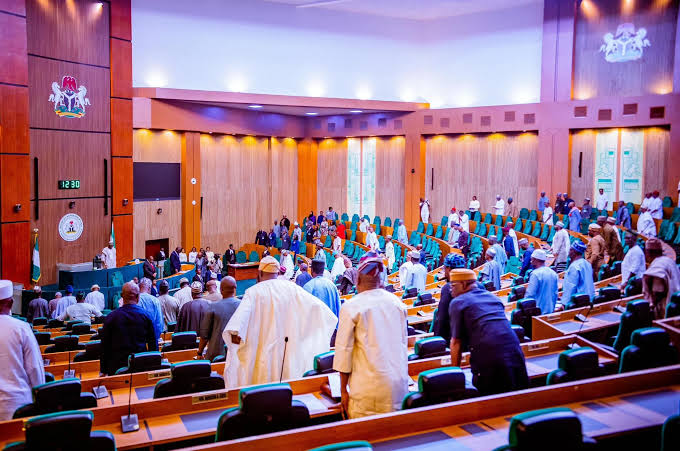
A member of the House Committee on Electoral Affairs, Fred Agbedi, has accused the leadership of the House of Representatives Nigeria of turning deliberations on the Electoral Act Amendment into a partisan exercise and sidelining minority lawmakers.
Agbedi, who represents the Peoples Democratic Party (PDP), made the remarks on Tuesday while speaking on Politics Today on Channels Television.
He argued that the legislative process should accommodate dissenting views, stressing that disruptions during plenary were triggered by what he described as the denial of members’ rights to be heard.
“In the lawmaking process, the people have their opinion. The beauty of democracy is that the majority will have their way while the minority will have their say.
“When you ignore members who raise points of order, that is what causes rowdiness. We all have equal rights, and when I speak, I am speaking for my people,” he said.
Agbedi further claimed that debate on the amendment initially cut across party lines but later became polarised when members of the All Progressives Congress (APC) were allegedly directed to vote as a bloc.
“At the beginning, there were no party lines; people believed the real-time transmission provision was good enough and reflected what Nigerians wanted. But when the majority party felt threatened, division was used, and APC members were called to one side of the House,” he stated.
He maintained that the outcome of the process did not reflect public expectations, adding that both lawmakers and citizens were “defrauded” by the final position.
His comments came as protests entered a second day at the National Assembly of Nigeria complex, where civil society groups and activists demanded that the amendment bill explicitly mandate real-time electronic transmission of election results to the Independent National Electoral Commission (INEC) portal.
Demonstrators also called for the passage of the Special Seats for Women Bill. Notable figures present at the protest included Omoyele Sowore, Oby Ezekwesili, Peter Obi, and Aisha Yesufu.
Security was heightened around the complex, with reports that tear gas was used to disperse parts of the crowd.
Inside the chamber, tensions flared during deliberations, with opposition lawmakers staging protests over the removal of the real-time transmission clause.
The Minority Caucus, led by Kingsley Chinda, criticised the decision, while Speaker Tajudeen Abbas presided over a heated voice vote.
Deputy Speaker Benjamin Kalu later chaired proceedings during clause-by-clause consideration, and Majority Leader Julius Ihonvbere moved a motion for a closed-door session to restore order.
The House eventually passed the harmonised Electoral Act 2026, retaining provisions that allow manual collation where electronic transmission fails — a position the opposition argues could open the door to manipulation.
Agbedi insisted that lawmakers must prioritise public confidence in the electoral process, warning that perceptions of exclusion could erode trust in future elections.
