

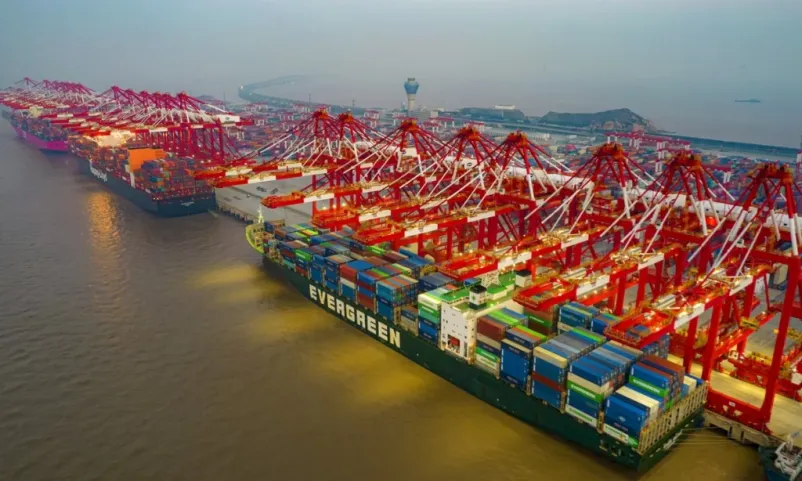
China posted a record $1.2 trillion trade surplus in 2025, as shifting global trade dynamics and US President Donald Trump’s “America First” policies prompted many countries to deepen economic ties with Beijing.
While renewed US tariffs and trade restrictions strained Washington’s relationships with traditional partners, China worked to rebuild and expand its trade networks across Europe, Asia, Africa, and Latin America. Analysts say this repositioning helped the world’s second-largest economy offset falling exports to the United States with strong growth in other regions.
Chinese exports to the US dropped by 20% in 2025, but shipments rose significantly elsewhere — up 25.8% to Africa, 13.4% to Southeast Asia, 8.4% to the European Union, and 7.4% to Latin America. The diversification contributed to record foreign exchange inflows, which reached $100 billion in a single month, and boosted China’s overall trade balance.
Beijing has also sought to present itself as a stable and predictable economic partner at a time when US trade policy has been described by some investors as uncertain. Economists note that China’s large domestic market, deep financial system, and expanding global trade links have made it an increasingly influential player in the global economy.
Diplomatic engagement has accompanied the trade push. British Prime Minister Keir Starmer began a four-day visit to China this week aimed at revitalising business ties, marking the first trip by a UK prime minister to Beijing since 2018. Earlier this month, Canadian Prime Minister Mark Carney also visited China, with both countries signing agreements to reduce trade barriers and strengthen economic cooperation.
At the same time, other major economies are pursuing their own trade diversification strategies. India and the European Union recently concluded a long-delayed trade agreement designed to cut tariffs and expand bilateral trade, reflecting a broader global effort to reduce reliance on any single market.
Despite ongoing geopolitical tensions with the United States, China’s economy met its official growth target of around 5% in 2025. Authorities introduced measures to support private businesses, stabilise financial markets, and attract foreign investment, including pilot programmes to open up sectors such as telecommunications, healthcare, and education.
China’s financial system has also shown resilience. The Shanghai stock index climbed 27% over the past year, and the country’s foreign exchange reserves rose to a 10-year high of $3.36 trillion. Meanwhile, Beijing has stepped up efforts to expand the global use of its currency, the yuan, in trade and finance. More cross-border transactions are now being settled in yuan, and some international banks are increasing yuan liquidity in offshore markets.
However, some foreign policy experts caution that improved trade relations do not necessarily erase longstanding concerns about China’s global role. Analysts point to ongoing disputes over trade practices, geopolitical tensions, and regional security issues as factors that could limit how far countries are willing to shift toward Beijing.
Still, as global trade patterns adjust to new political and economic realities, China’s record trade surplus highlights how major economies are recalibrating partnerships in response to a more fragmented and competitive international landscape.
